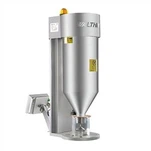
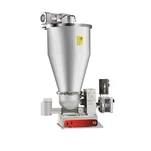
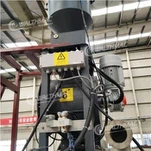
The main engine of the plastic extruder is the extruder, which consists of an extrusion system, a transmission system and a heating and cooling system.
1. Extrusion system The extrusion system includes a screw, a barrel, a hopper, a head, and a mold. The plastic is plasticized into a uniform melt through the extrusion system, and under the pressure established in this process, it is continuously fed by the screw. extruder head.

(1) Screw: It is the most important part of the extruder, which is directly related to the application range and productivity of the extruder. It is made of high-strength and corrosion-resistant alloy steel.
(2) Barrel: It is a metal cylinder, generally made of alloy steel with heat resistance, high compressive strength, strong wear resistance and corrosion resistance or composite steel pipe lined with alloy steel. The barrel cooperates with the screw to realize the pulverization, softening, melting, plasticizing, exhausting and compacting of the plastic, and continuously and uniformly convey the rubber material to the molding system. Generally, the length of the barrel is 15 to 30 times its diameter, so that the plastic can be fully heated and fully plasticized.
(3) Hopper: The bottom of the hopper is equipped with a cutting device to adjust and cut off the material flow, and the side of the hopper is equipped with a sight hole and a calibration metering device.
(4) Machine head and mold: The machine head is composed of an alloy steel inner sleeve and a carbon steel outer sleeve, and a forming mold is installed in the machine head. The function of the machine head is to convert the rotating plastic melt into parallel linear motion, evenly and smoothly introduce it into the mold sleeve, and give the plastic the necessary molding pressure. The plastic is plasticized and compacted in the barrel, and the porous filter plate flows into the molding die of the die through the neck of the die along a certain flow channel. A continuous and dense tubular cladding layer is formed around the core wire. In order to ensure a reasonable plastic flow channel in the machine head and eliminate the dead angle of accumulated plastic, a shunt sleeve is often installed. In order to eliminate the pressure fluctuation during plastic extrusion, a pressure equalizing ring is also installed. The machine head is also equipped with a mold correction and adjustment device, which is convenient for adjusting and correcting the concentricity of the mold core and the mold sleeve.
According to the angle between the material flow direction of the head and the center line of the screw, the extruder divides the head into an oblique head (with an angle of 120°) and a right-angle head. The shell of the machine head is fixed on the fuselage with bolts. The mold in the machine head has a core seat and is fixed to the wire inlet port of the machine head with a nut. The front of the mold core seat is equipped with a mold core, a mold core and a mold core seat. There is a hole in the center for passing the core wire; a pressure equalizing ring is installed in the front of the machine head to equalize the pressure; the extrusion molding part is composed of a die sleeve seat and a die sleeve, and the position of the die sleeve can be adjusted by bolts through the support , in order to adjust the relative position of the die sleeve to the die core, so as to adjust the uniformity of the thickness of the extruded cladding layer. The outside of the machine head is equipped with a heating device and a temperature measuring device.
2. Transmission system The function of the transmission system is to drive the screw and supply the torque and speed required by the screw during the extrusion process, which is usually composed of a motor, a reducer and a bearing.
3. Heating and cooling device Heating and cooling are necessary conditions for the plastic extrusion process to be carried out.
(1) At present, the extruder usually uses electric heating, which is divided into resistance heating and induction heating. The heating device heats the plastic in the cylinder externally to heat it up to the temperature required for the process operation.
(2) The cooling device is set up to ensure that the plastic is in the temperature range required by the process. Specifically, it is to remove the excess heat generated by the shear friction of the screw rotation, so as to avoid the plastic decomposition, scorch or difficulty in shaping due to excessive temperature. Barrel cooling is divided into two types: water cooling and air cooling. Generally, air cooling is more suitable for small and medium-sized extruders, and water cooling or a combination of the two forms is used for large extruders. The screw cooling mainly adopts central water cooling, in order to increase the solid conveying rate of materials. , to stabilize the glue output and improve the product quality at the same time; but the cooling at the hopper is to strengthen the conveying effect of the solid material, prevent the plastic pellets from sticking and block the material port due to the temperature rise, and the second is to ensure the normal operation of the transmission part.